
November 20, 2026
Tracking Service History by Frame Serial Number for Warranty Claims
What every bike shop should store against the frame serial so warranty claims on frames, forks, motors and batteries get approved the first time.
By Eric Lamanna

What data does a shop need to bind to a frame serial so warranty claims on frames, forks, motors and batteries clear? The serial itself, the original buyer and purchase date, a photo of the stamping, the matched invoice, and the component serials for motor, battery and fork, all captured at intake.
Below is a per-bike record schema that holds up to a distributor packet, plus a workflow for building that record on the first visit instead of reconstructing it later from a credit-card statement.
The fields change a little for e-bikes, and the paper trail changes a lot for a bike that has passed through two owners. Both get their own section.
The Frame Serial Carries the Whole Claim File
Frame warranties on new bikes are commonly limited to the original owner on a lifetime basis, and the claim hangs on whether your record shows this frame attached to this buyer. Trek requires that a bicycle be registered with Trek Bicycle Corporation before a warranty claim can be processed, and limits the frameset lifetime warranty to the original owner. Factor Bikes ends coverage outright when the original buyer transfers ownership to a third person.
Federal rules sit underneath the brand terms. Under the Magnuson-Moss Warranty Act, any written warranty on a consumer product costing more than $10 must be designated either full or limited, and warranties on products over $15 must be made available to consumers before purchase.
Then there is the format problem. Bicycle serial numbers follow no universal standard: each manufacturer invents its own format, which can be all digits, mixed letters and numbers, or year-coded, and usually runs six to twenty characters. Your record has to capture what is stamped on this frame, not a cleaned-up version of it.
The Fields to Bind to Every Serial
A per-bike record that will survive a claim carries, at minimum:
- Frame serial, exactly as stamped, with case and leading zeros preserved
- Location of the stamping: BB shell, head tube, rear dropout, or underside of the downtube
- Photograph of the serial in place on the frame
- Make, model, model year, color, size
- Original retail invoice number, retailer, and date of first retail sale
- Buyer name, email, phone, and current address on file
- Shop record ID linking the frame to the service ticket history
- For e-bikes: motor serial, battery serial, firmware version at delivery
- Fork brand, model year, and any damper or steerer serial separately marked
The last line is not padding. In July 2025, Giant recalled about 6,200 Momentum Vida E+ e-bikes for a fork steerer-tube fracture hazard, with the third character of the serial stamped on the left rear dropout deciding whether the fork had to be replaced at all. If your intake record is a sticker and a model name, you have a long phone call ahead. If the serial and a dropout photo are in the file, the answer takes a minute.
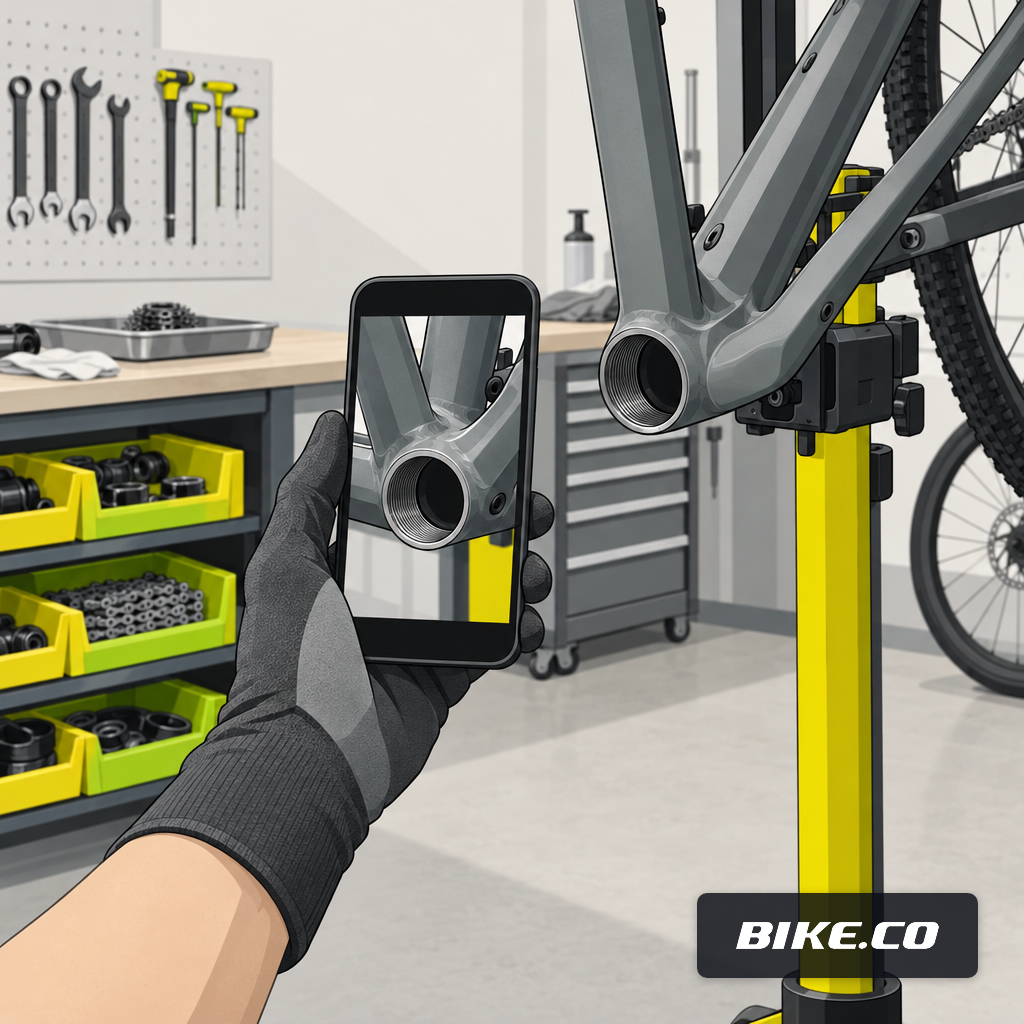
Capture It at Intake, Not When Claims Open
If the serial is not captured on the first visit, it rarely gets captured later. The bike leaves, the customer moves, and when a battery fails three years in, you are reconstructing the record from a card statement and the memory of whoever rang up the sale.
Build a short intake step and run it every time: scan or type the frame serial into the ticket, photograph the stamping, attach the retail invoice as a PDF, and confirm the buyer's contact details against the file you already have. A bike shop management system that treats the per-bike record as a first-class object, not a note on a ticket, is the only setup where this stays light work. Paper tickets and a POS note leave you with a record that is thin two years out and useless four years out.
The same intake moment is where photo-approved repair quotes go in. The warranty record uses the same photos.
The recall curve is why this matters more than it used to. E-bikes bring battery, motor and firmware into the warranty conversation, and recalls on those parts move tens of thousands of units at a time.
Motor and Battery Fields Deserve Their Own Slots
Motor and battery data should not be folded into a free-text notes field. The motor and the battery each carry their own warranty terms, often shorter than the frame, and often tied to a build date rather than the retail date. Serial formats differ between a Bosch and a Shimano, and between generations of either.
Store the fields separately per bike:
- Motor brand and serial
- Battery brand, model, capacity in watt-hours, and serial
- Firmware version at delivery, and at every service event afterward
- Charger model and serial
- Date the battery was first put into service
- State-of-health reading at the most recent service
Battery warranties are commonly expressed in both months and charge cycles. If the service history does not log a state-of-health reading at each visit, a claim on degraded capacity turns into a harder argument. Shops that already lean on their service CRM fields for the per-bike record can set this up as named columns rather than freeform notes.
What the Claim Packet Needs to Contain
A clean submission to a distributor has four parts: identity, ownership, failure, and history. The packet does not need to be long. It needs each part to be there.
- Identity: the serial, make, model, size, color, with photos of the stamping in place on the frame
- Ownership: the original retail invoice tied to the buyer by name and date
- Failure: a short description with photos or a short video, and the failed part's own serial if it has one
- History: dated service entries covering what was touched and when, plus any earlier related failures on this bike
If the file carries all four parts, distributors spend less time on email and more on the authorization. If one part is missing, the clock stops until you dig it up. Shops that already run a single platform for service, records and parts find the warranty packet is mostly already written by the time the claim opens.
The Same Record Carries When a Bike Goes Missing
Serial records do not stop earning when the warranty window closes. Theft recovery runs on the same number, and your customer will come back to ask for it.
The drop between bikes stolen and bikes returned is wide, and a lot of the drop is a records problem rather than a policing problem.
Cities where a serial-based registry has taken hold recover more. A shop that already records serial, invoice and buyer on every sale is effectively running a small private registry, and that record is what the owner will reach for when the bike is gone. The same intake discipline that clears a warranty claim clears a police report.
Looking Ahead to the 2027 Claim Cycle
The change most likely to affect how you file claims next year is manufacturer-side consolidation of registration portals. More brands are moving toward requiring digital registration at the point of sale, and recall notices are increasingly keyed to serial lookups rather than batch numbers printed on a flyer. If your intake flow already pushes the frame serial, the receipt, and the component serials into one per-bike record, that shift is a non-event. If it does not, it will show up one claim and one battery at a time, through a year in which e-bike recall volumes are not trending down. A shop weighing how different systems hold that record can start with the comparison of bike shop software options and work out which fields it already has slots for.
Eric Lamanna · Director of Business Development
Eric Lamanna is Director of Business Development at erp.io, the suite BIKE.co runs on. He works with the people who have to live with shop software after the demo ends — the owners and service managers deciding whether the tag-and-whiteboard system can survive another spring rush. Most of his time goes on the unglamorous half of that problem: who approves a quote when the customer calls back, where the service queue depends on one mechanic's memory, and what moving a customer list really costs once the cleanup is counted honestly. He came to operations software through digital sales and product work, with a long-running interest in automation and security — the two places where a manual process quietly becomes a liability. He is a believer in workflows that hold up when somebody is out sick, which on a busy bench is most weeks. Eric holds a degree in multimedia design from Olympic College and lives in Denver, Colorado, with his wife and children.